1. A quiet revolution in how we work
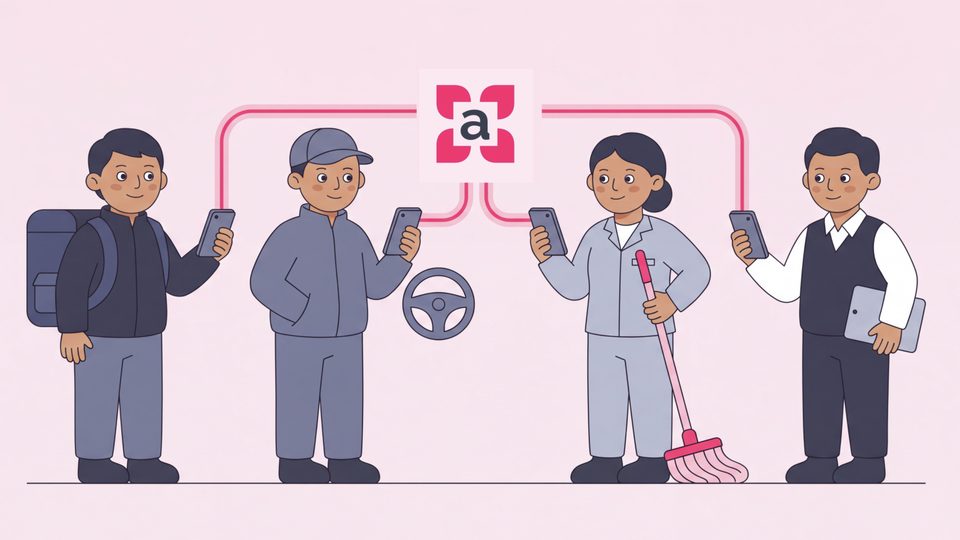
Just ten years ago, “finding a side job” meant putting up flyers or asking friends. Today a courier starts a shift through an app, a tutor gathers students in a messenger, a driver switches on an aggregator — and each of them earns income without signing an employment contract or coming to an office. This is not an exception but a shift in the very architecture of work: a digital platform now stands between a person and their work.
For some it is freedom and extra income; for others it is a primary yet fully legal income. The model grew faster than the law, and governments worldwide are writing rules to fit it. Kazakhstan is no exception — and in 2026 it takes a notable step.
How money, taxes and documents flow
Basis: Articles 718–721 of the Tax Code of Kazakhstan. The 4% breakdown is per the State Revenue Committee.
2. What platform employment is
Platform employment is a model where a person receives orders and payment through a digital platform rather than being hired onto a company's staff. The contractor decides when and how much to work; the platform takes on finding orders, settlements and often documents and taxes. This model is often called the gig economy (from “gig”, a one-off job).
It is important to distinguish it from two neighbouring phenomena. From classic employment, platform work is set apart by the absence of an employment contract, a schedule and subordination: pay is for a result, and the contractor pays their own taxes. From “free” freelancing, it differs by having a platform intermediary that standardises settlements, ratings and closing documents. By various international estimates, hundreds of millions of people work in the world's gig economy, and the share of such workers steadily grows.
3. Kazakhstan in numbers
In Kazakhstan platform employment has grown from a niche phenomenon into a notable segment of the labour market. According to the State Revenue Committee, about 369,000 people earn income through digital platforms; some market studies give broader estimates — up to half a million, or roughly 5–6% of the workforce. For context: the country has about 2.1 million self-employed people, according to the Bureau of National Statistics.
The market's structure is recognisable: the largest areas are taxi and courier delivery, followed by household services, tutoring, beauty and repair. The state has already plugged into this infrastructure technically: integration with dozens of platforms has been done (around 33, per the State Revenue Committee), and a significant share of them act as tax agents, withholding payments automatically.
4. What drives growth
- The smartphone as a workplace. High penetration of mobile internet and payments has made entry into platform work almost instant.
- Demand for flexibility. People want income without a rigid schedule; businesses want “on-demand” contractors without inflating headcount.
- The aggregator effect. Large taxi and delivery services accustomed both contractors and clients to the “order in an app” model.
- A demand for legalisation. Simple registration and a minimal tax make transparent income convenient and worthwhile.
5. The state steps in: the 2026 regime
From 1 January 2026 the new Tax Code introduced a special tax regime for the self-employed — including those who work through internet platforms. The logic is built for the mobile era: income is recorded by a receipt in the e-Salyq Business app, income tax is 0%, the single social payment is 4%, and limits of 300 MCI per month and 3,600 MCI per year apply. More in the guide to self-employment and the article on the new 2026 Tax Code.
The key idea is to shift administration onto the platforms: they check status, withhold the payment and generate the receipt, leaving the person to work. In parallel, the law fixes the correct model of relations: from 8 June 2026 it is directly prohibited to disguise employment as a civil-law contract (see the GPH ban). For conscientious companies this is a plus: the rules of the game have become clearer, and correct work with the self-employed safer.
6. What it means for business and people
For companies, platform employment means access to a large pool of contractors without payroll costs, with clear and predictable paperwork: a verified status, a result-based contract and a receipt for every payout. For contractors, it means freedom, easy entry and transparent, fully legal income.
In practice, the winner is whoever builds the process carefully. It is precisely the “boring” layer — settlements, statuses, documents — that turns flexibility into a stable, predictable model equally convenient for the client and the contractor.
7. Where the market is heading
The trend is long-term: the share of platform employment worldwide and in Kazakhstan will keep growing, while regulation becomes more convenient and clearer. Likely directions are an expansion of the list of activity types, closer integration of platforms with government services and the development of convenient digital tools for businesses and contractors. The winners will be the platforms and companies that make compliance invisible and built-in — part of the product itself rather than a separate routine.
Data sources: estimates and services of the State Revenue Committee (the number of people working through platforms, platform integration), the Bureau of National Statistics (the number of self-employed), industry studies of Kazakhstan's platform economy; the Tax Code of Kazakhstan (Law No. 214-VIII of 18 July 2025). Estimates of the number employed vary by methodology. This material is analytical and for reference.